Glue dots vs continuous seam application: choosing the right adhesive method
Ask any production manager what keeps them up at night, and “adhesive application” will not be top of the list.
However, they do lose sleep over what happens when the application goes wrong. In this case, bond failure, unplanned downtime and the cost of scrapping half a shift’s output because the glue did not hold.
A glue dot at one point on a pack does a very different job to a continuous seam running the full length of a paper straw or cigarette wrapper. Getting it wrong affects more than bond quality. It impacts waste, line output, maintenance, and the cost of every unit off the line.
This guide explains what each method does and when to use it. It also explains why pump-controlled continuous seam application outperforms dots in most high-speed manufacturing scenarios.
Both methods work with any adhesive type, whether hot melt adhesive systems or PVA adhesive solutions. The choice comes down to what the bond needs to achieve, not which adhesive is in use.
How glue dot application works: precision bonding at specific points
A glue dot applicator fires one controlled shot of adhesive at a set location. The system triggers, deposits, and resets. This places adhesive at defined points rather than along a continuous line.
Think of a glue dot machine like a stapler. One press gives you one bond point. You then move to the next spot and fire again.
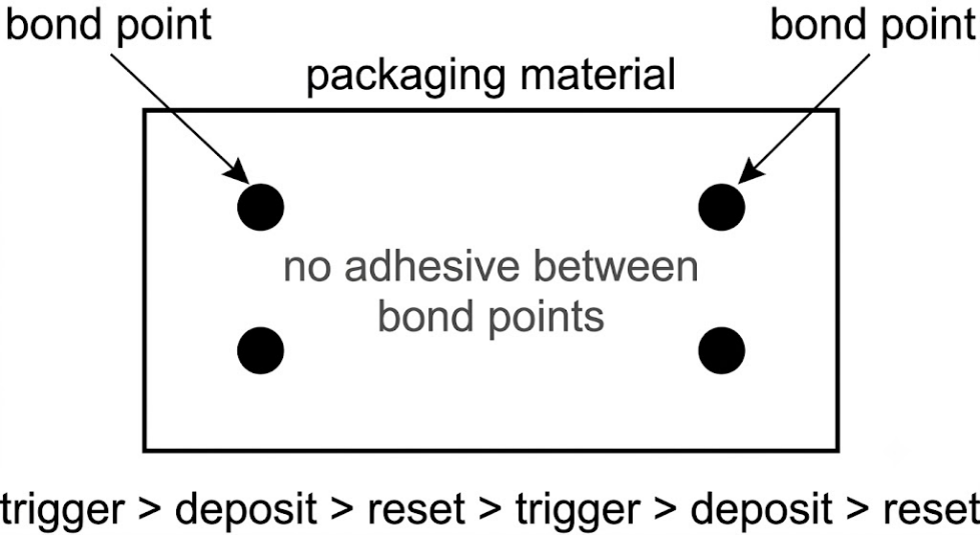
Fig. 1: Glue dot application. Each dot is a discrete trigger event. Adhesive is placed only at defined bond points, with gaps between.
When glue dots are the right fit
Glue dots work best when position matters more than coverage. Picture a promotional leaflet tacked into a retail carton. You need it to sit flat, stay put, and come out cleanly when the customer opens the pack. A dot at each corner does exactly that.
A continuous seam application would bond more of the insert than intended. It would create squeeze-out along the edge and make the insert hard to remove.
The same applies to label attachment, point closures and light component bonding. Any time the job is “hold this here” rather than “seal this edge,” use glue dots. These adhesive application techniques are ideal for localised, non-structural bonds.
Limitations of glue dot application
Where a bond must run continuously along a seam, fold or edge, a row of dots cannot match a solid adhesive line.
On high-speed lines, timing becomes a real problem. The system must fire, deposit, and reset within increasingly short time windows. If it becomes uncoordinated with the machine’s speed sensor, placement accuracy drops.
There is also less control over how much glue lands on each product. Each dot is isolated and not part of a controlled flow. When a dot lands off target, it often goes unseen until a pack inspector catches it. By then, you may have hours of output waiting for rework.
How continuous seam application works
Continuous seam application lays an unbroken line of adhesive along a join, fold or edge as the material moves through the machine.
Instead of firing at set points, the system delivers a steady, controlled flow along the full bonding path.
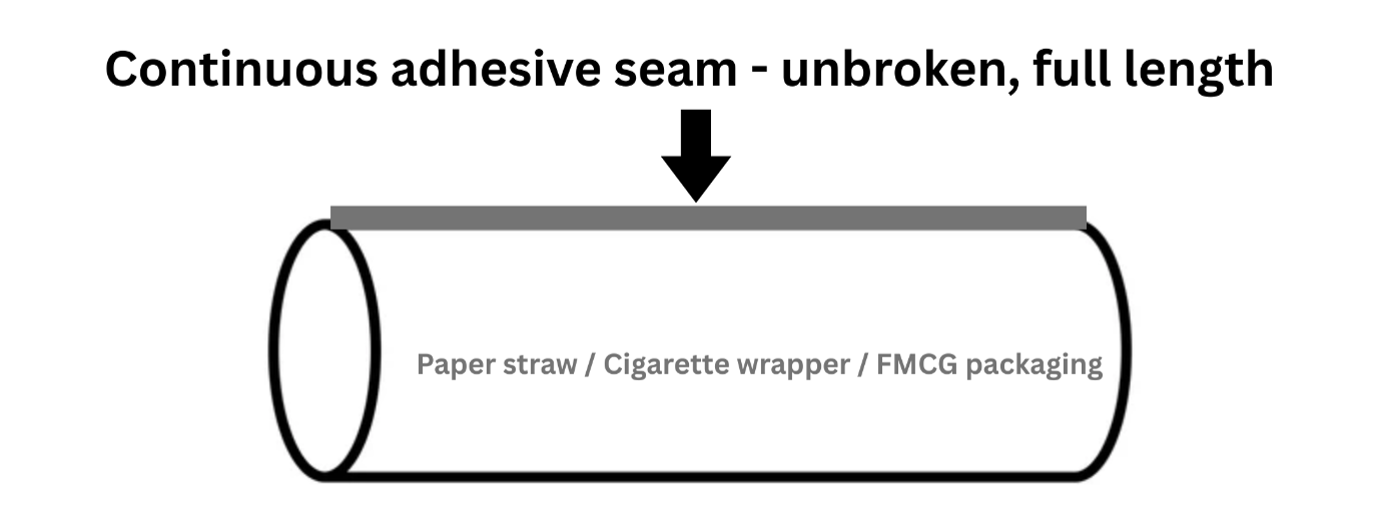
Fig. 2: Continuous seam application along a paper tube. The adhesive line runs the full length of the join with no gaps, maintaining structural bond integrity from end to end.
When continuous seam application is the right fit
The easiest way to see where continuous seam is the right application style is by picturing what happens when you try glue dots instead.
A paper straw sealed at four points rather than along an unbroken seam will hold its shape until the first time someone bites down or draws liquid through it. The gap between bond points is a failure point. When you produce millions of units, a gap in every adhesive line is a failure in every unit.
The same pattern plays out across manufacturing. In cigarette and filter production, the adhesive lines must run without gaps for the product to work correctly. In FMCG packaging, a seam that fails under fill pressure or transit vibration means damaged stock. In home care, seams carry stacking loads that isolated bond points cannot handle.
The bond in all these cases is not decorative. It is structural. Continuous seam application is the only method that can guarantee it holds.
Why pump-controlled seam application delivers better results at speed
The key advantage of continuous seam on a high-speed line is pump control. The pump responds to machine speed directly. As the line speeds up, the flow rate goes up to match. As it slows, the flow drops. The volume of glue per unit length stays consistent, regardless of the speed.
A trigger-based dot system cannot replicate this across the full operating range.
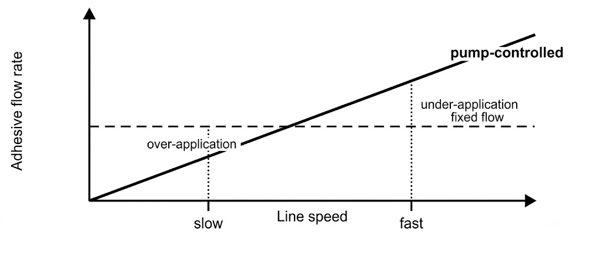
Fig. 3: Pump-controlled adhesive flow scales proportionally with line speed, keeping glue volume per unit length consistent. A fixed flow rate creates over-application at slow speeds and under-application at fast speeds.
In practical terms, controlled glue volume means every product receives exactly the volume of adhesive it needs, no more and no less.
Under-application, which causes bond failure, dry spots and rejected product, is prevented because the pump ensures sufficient adhesive reaches every point of the seam. Over-application, which wastes material and creates contamination and downstream handling problems, is equally avoided.
Squeeze-out, where excess adhesive spreads beyond the bond zone under compression, is reduced because the volume is precisely matched to the requirement. The net result is reduced waste, cleaner machine running and higher line efficiency.
SPI’s glue application systems are built around a Programmable Pump Controller and Micro Precision Pump. Together, they give precise, continuous control over adhesive flow rate.
With more than 1,000 pump-driven lines installed in manufacturing operations worldwide, these modular systems easily fit cigarette, cigar, filter, paper straw, FMCG, and home care machinery.
They can also be combined with flavour application and other liquid handling through one control interface.
Glue dot vs continuous seam application at a glance
Here’s an easy-to-digest snapshot of which glue application style suits particular use cases:
| Criterion | Glue dot application | Continuous seam application |
| Deposition pattern | Discrete dots at specific bond points | Continuous line along a join, fold, or edge |
| Bond continuity | Intermittent; gaps between bond points | Unbroken; continuous seam integrity |
| Glue volume control | Per-dot volume; independent events | Pump-controlled flow proportional to line speed |
| Speed suitability | High, but constrained by trigger cycle time | High; flow adjusts automatically with speed |
| Squeeze-out risk | Low (small discrete deposits) | Low when pump-controlled (precise volume matching) |
| Waste profile | Low per bond point; no coverage waste | Low overall; proportional flow minimises excess |
| Inline detection | Optical or capacitive dot verification | Glue line sensor scanning full paper width |
| Typical use cases | Insert tacking, label attachment, point closures | Lap-seam, anchorage lines, swirl lines, longitudinal seams |
| Best for | Intermittent, positionally specific bonds | Structural seams where bond integrity is critical |
How to decide between glue dot and continuous seam application
The decision starts with the bond requirement, not the adhesive. Both methods can work with any adhesive type when the system is correctly configured. The questions that determine the method are about what the bond needs to do.
Choose glue dot application when:
- – The bond is needed at set points, not along a continuous path
- – Adhesive must stay within a defined zone
- – The bonding is intermittent, with gaps between bond points
- – Adhesive must not appear outside a tightly defined zone
- – The job is tacking, attaching or positioning, not structural seaming
Choose continuous seam application when:
- – The bond must run along a seam, fold, edge or join without interruption
- – Seam integrity directly affects product quality or structural performance
- – Controlled glue volume, avoidance of under or over-application and reduced waste are priorities
- – The line runs at variable speeds, and adhesive flow must adjust proportionally
- – Inline detection needs to verify the full length and coverage of the adhesive line
Common mistakes when choosing an adhesive application method
Understanding the world of adhesive application systems can be confusing, and manufacturers from all types of industries often make common mistakes when selecting an appropriate system. Such as:
Defaulting to dots out of habit.
Dots are sometimes chosen because that is what the previous line used, or because the bond requirement was never fully defined. If the bond must run along a seam, fold or edge, continuous application is the right method. That is true regardless of what came before.
Overlooking glue volume control.
On a high-speed line, the amount of glue applied changes as the line speeds up or slows down. This produces inconsistent bonds. Pump-controlled systems fix this by matching flow to machine speed across the full operating range, not just at one set point.
Assuming the applicator running means the bond is there.
That is not a quality system. SPI’s glue application system features a Glue Line Sensor that scans the full width of the paper to verify that glue application is within tolerance, triggering an eject signal when it is not. Inline verification should be part of the specification from the outset, not something added after a quality incident.
Confusing adhesive type with adhesive application method.
Hot melt and PVA are adhesive types. Glue dot and continuous seam are application methods. Any adhesive works with either method when the system is set up correctly. Mixing up these two decisions often leads to the wrong method being chosen for the wrong reason.
Choosing the right method for your production line
Explore SPI’s glue application systems range to see how continuous seam and other application methods are configured for high-speed production environments.
If you are evaluating which application method suits your line, or ready to specify a system, speak to the team at SPI today.
Frequently asked questions
What is the difference between glue dot and continuous seam application?
Glue dot application places discrete, individually triggered dots of adhesive at specific bond points. Continuous seam application lays an unbroken adhesive line along a join, fold or edge.
When should I use glue dots?
Glue dots are the right fit when the bond is needed at specific, isolated points rather than along a continuous path. Common applications include insert tacking, label attachment, promotional item placement and point closures in packaging.
What are the advantages of continuous seam application?
Pump-controlled continuous seam application delivers controlled glue volume proportional to machine speed, prevents under-application and over-application, reduces squeeze-out and minimises waste.
How does pump-controlled adhesive application work?
A pump-driven system delivers adhesive at a flow rate linked directly to machine speed: as the line accelerates, the flow increases; as it slows, the flow decreases. The volume of adhesive per unit length of seam remains consistent regardless of speed variation, ensuring even application across the full operating range.
Can the same adhesive be used with both methods?
Yes. Both glue dot and continuous seam application work with any adhesive type, including hot melt, PVA and other formulations, provided the system is configured for the viscosity and temperature of the adhesive being used.